3M™ Scotch-Weld™ Adhesives - Applications and Product Selection
3M™ Scotch-Weld™ Structural Adhesives represent the apex of chemical joining technology, offering engineers and manufacturers a powerful alternative to traditional methods like welding, riveting, and bolting. Designed for applications where the bond line must sustain significant static and dynamic loads, the Scotch-Weld portfolio is a highly specialised range of solutions built upon decades of polymer science.
The Engineering Imperative: Why Move Beyond Mechanical Fasteners?
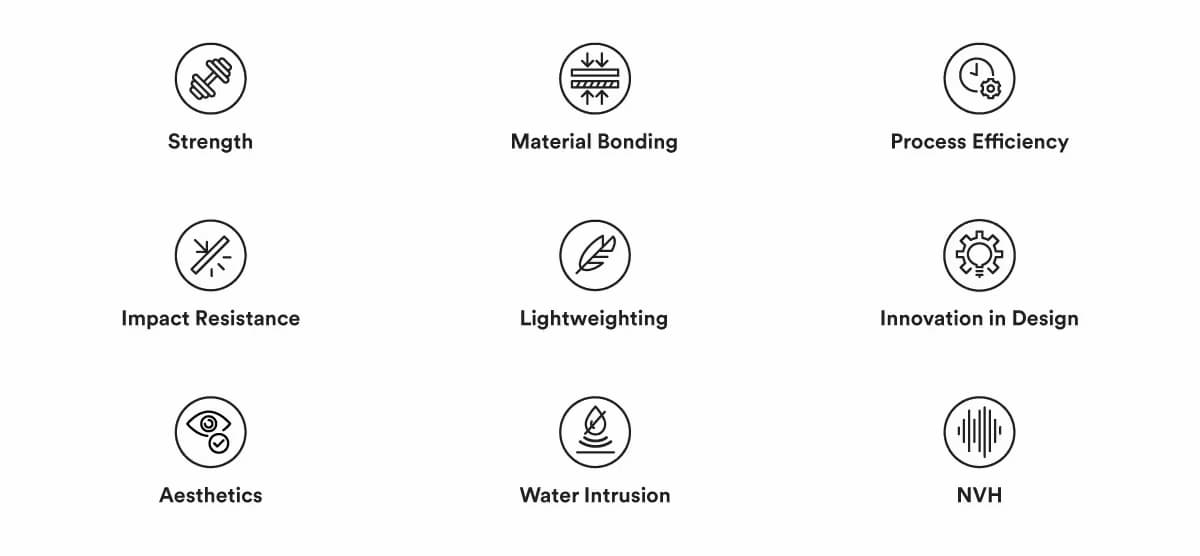
The shift toward structural adhesives is driven by critical performance requirements in modern design, particularly the need for lightweighting and multi-material assembly (e.g., bonding aluminium to carbon fibre).
|
Performance Attribute |
Mechanical Fastener (Rivets/Welds) |
3M Scotch-Weld Structural Adhesives |
|
Stress Management |
Stress Concentration at fixed points (holes/welds). |
Stress Distribution across the entire bond line. |
|
Fatigue Resistance |
Lower due to localised stress points. |
Higher; the bond often acts as a vibration damper. |
|
Dissimilar Materials |
Risk of Galvanic Corrosion (especially metals). |
Excellent joining capability; provides a dielectric barrier to prevent corrosion. |
|
Aesthetics/Finish |
Requires grinding, filling, or visible joins. |
Invisible bond lines for superior surface finish. |
Structural Adhesive Chemistries: Expert Breakdown
The versatility of the Scotch-Weld family stems from its core chemistries, each optimised for distinct mechanical properties and production environments.

1. Epoxy Adhesives (High Strength, Environmental Resilience)
Mechanical Profile: Known for exceptional high cohesive strength and minimal shrinkage upon cure, providing a rigid, load-bearing bond.
Key Advantage: Unmatched environmental resistance to harsh chemicals, moisture, and extreme temperatures.
Application Focus: Ideal for critical, long-term assemblies where high sheer and peel strength are mandatory, such as aerospace structures, magnets, and high-performance sporting goods.
Forms: Available as one-part, heat-curing systems (for highest strength) and two-part, room-temperature curing systems (for field or MRO applications).

2. Acrylic Adhesives (Fast Cure, Minimal Prep)
-
Mechanical Profile: Provide an excellent balance of strength and impact resistance. The two-part system is known for its rapid cure profile, drastically reducing jig and handling time.
-
Key Advantage: Exceptional ability to bond Low Surface Energy (LSE) plastics with minimal or no surface preparation, significantly simplifying the production process.
-
Application Focus: High-speed manufacturing lines, metal fabrication, and structural bonding of plastics (e.g., HVAC, transportation assembly).

3. Urethane Adhesives (Flexibility and Dampening)
-
Mechanical Profile: Characterised by superior flexibility and elongation, allowing the bond line to move and absorb stress. They possess inherent vibration and noise damping properties.
-
Key Advantage: Perfect for bonding materials with significantly different coefficients of thermal expansion (CTEs), such as glass to metal or large composite panels, preventing failure due to thermal cycling.
-
Application Focus: Specialty vehicles, window bonding, and any application requiring a strong, yet flexible, seal against fatigue.

4. Polyurethane Reactive (PUR) Adhesives (Hybrid Speed and Strength)
-
Mechanical Profile: A unique hybrid that cures in two stages: an initial set as a hot melt (providing quick handling strength in seconds) followed by a full structural cure as the material reacts with ambient moisture.
-
Key Advantage: Combines the speed of assembly of hot melts with the final performance of a structural adhesive.
-
Application Focus: Electronics, appliance assembly, and woodworking where instant positioning and fast throughput are essential before the full structural bond is achieved.
Product Selection Guide: Choosing Your Scotch-Weld Solution
Selecting the correct structural adhesive requires defining the specific requirements of the application, not just the materials being bonded.
|
If your primary need is... |
The Recommended 3M Scotch-Weld Chemistry is... |
Key Substrates/Bonding Focus |
Example Applications |
|
Ultimate Strength & Heat/Chemical Resistance |
Epoxy |
Metal-to-Metal, Composites (CFRP/GFRP), Magnets. |
Engine components, tool assemblies, golf clubs. |
|
Fastest Curing & Bonding LSE Plastics |
Acrylic |
Metals (steel, aluminium) and Plastics (PP, PE, ABS). |
Signage assembly, plastic enclosures, rapid metal fabrication. |
|
Vibration Dampening & Thermal Flexibility |
Urethane |
Dissimilar Materials, Glass, Large Panels. |
Vehicle body panels, floor panel bonding, sealing. |
|
Instant Handling Strength (High Throughput) |
Polyurethane Reactive (PUR) |
Wood, Plastics, Ceramics. |
Furniture manufacturing, electronics casing assembly. |
As a specialist distributor, Techsil offers the full range of 3M Scotch-Weld Structural Adhesives. Contact our technical team today to leverage our expertise in Finite Element Analysis (FEA) and bond line design to select and integrate the optimal solution for your production line.
To find out more or get guidence on choosing the right product for your application, contact a specialist here: BOOK A CONSULTATION
or click below to access our 3M Product Selector