
Commercial UAV Production: Materials & Applications
Faster Assembly, Stronger Protection and More Reliable Platforms
Commercial UAVs are no longer niche machines used by a small group of specialist operators. They are now working across inspection, surveying, mapping, fire safety, delivery, agriculture, film, television, construction, utilities, security and infrastructure maintenance. The aircraft may differ in size, payload and flight profile, but the engineering challenge is often the same: build a lightweight platform quickly, then keep it reliable in vibration, weather, heat, impact and repeated field handling.
For UAV manufacturers, production speed is becoming as important as flight performance. A design that takes too long to assemble, seal, clamp, cure or inspect can become difficult to scale. Adhesives, sealants, tapes and thermally conductive materials can make a direct contribution here. They can reduce drilling, remove secondary fixing operations, bond dissimilar materials, seal against ingress and protect sensitive electronics. TECHSiL’s UAV and UGV material guidance focuses on exactly these requirements: ruggedisation, reliability, environmental protection, thermal stability and lightweighting.
Where adhesives improve UAV build speed
Mechanical fixing still has its place in UAV construction, particularly where service access is required. Adhesive bonding gives manufacturers another route for assemblies where speed, weight, sealing and stress distribution are priorities.
A bonded joint can spread load across a larger area than a rivet or screw. On composite arms, moulded housings and lightweight frames, this can reduce local stress points and avoid unnecessary holes in the structure. In production, that means fewer drilled features, fewer loose components, fewer finishing steps and less time spent managing water ingress around penetrations.
Fast curing grades are especially valuable where the bottleneck is handling time. If a part can be fixtured in seconds or minutes, the next build stage can begin sooner. For higher volume UAV production, that can make a real difference to work-in-progress, fixture availability and output.
Structural bonding for arms, frames and landing gear
Commercial UAV arms, frames and landing gear are exposed to repeated vibration, hard landings, payload changes and outdoor service conditions. For these assemblies, material selection needs to consider strength, impact resistance, substrate compatibility and production flow.
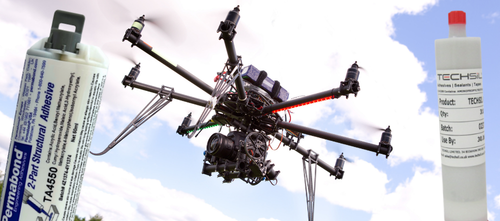
Permabond TA4550 is a useful option for mixed substrate UAV assemblies. It is a two-part toughened acrylic developed for structural bonding of nylon and polyamide without primers or plasma treatment, and it is also suited to plastics, composites and metals. It cures rapidly at room temperature and is designed for applications involving impact and vibration. It also has a 3 minute pot life, 5 to 6 minute fixture time, 2 hour working strength and 24 hour full cure at 23°C, making it relevant where rapid handling is required in production.
ET5428 toughened epoxy is suited to composite frame, arm and structural bonding where a tougher epoxy system is required. Clean, dry, grease-free surfaces remain essential, with some metals benefiting from light abrasion before bonding. The datasheet notes full cure after 24 to 48 hours at 23°C, with heat available to accelerate the curing process.
For UAV manufacturers building inspection, survey and filming platforms, these materials can support strong structural assemblies without adding unnecessary mechanical hardware. For delivery UAVs or fire safety platforms, where payload, vibration and environmental exposure are more demanding, the same bonding principles can help improve durability and repeatability.
Motors, magnets and vibration-prone assemblies
Motor assemblies, magnet bonding, mounts and vibration-prone components need fast handling strength and reliable performance under repeated mechanical load. Permabond TA439 is a two-component structural acrylic designed primarily for bonding metals, ferrites, ceramics and some plastics. It has a typical fixture time of 20 to 40 seconds and is described as suitable for high speed production lines.
For UAV production, that fast fixture time is significant. Motor and mount bonding operations should not hold up the rest of the build. TA439 also provides handling strength in 40 to 75 seconds, working strength in 3 to 5 minutes and full cure in 24 hours at 23°C. TECHSiL’s UAV guidance identifies TA439 for motor vibration proofing, magnet bonding and mount bonding, alongside F200 threadlocker where threaded fasteners still form part of the assembly.
Sensors, cameras and payload fixtures
Many commercial UAVs are built around the payload: thermal cameras for fire safety, LiDAR for surveys, high resolution cameras for inspection, stabilised camera systems for film and television, or specialist sensing equipment for industrial monitoring.
These assemblies need accurate positioning, low movement, vibration resistance and protection from moisture and dust. Permabond UV639 is relevant for clear plastics, acrylic, polycarbonate, PETG, glass and metals. It is a UV curing adhesive with cure-on-demand behaviour, high transparency and low shrinkage. On PMMA, typical fixture time is 5 seconds with a low power battery lamp or under 1 second with a suitable LED lamp, depending on lamp output, distance and substrate transmission.
For UAV production, UV cure adhesives can be valuable where parts need to be aligned first and cured only when correctly positioned. That can help with camera windows, optical housings, sensor covers and transparent protective features.

Batteries, power electronics and thermal management
Power density is a growing challenge in UAV design. Batteries, ESCs, processors, radios, cameras and sensing modules all generate heat inside compact assemblies. Poor thermal management can reduce reliability, shorten component life and compromise performance during demanding flight cycles.
Permabond MT3836 is a two-part modified hybrid silane polymer adhesive for sealing and bonding. It has excellent adhesion to polycarbonate, ABS, nylon, other plastics and a variety of metals. It is also designed to meet UL94 V-0 fire retardancy requirements. It offers a 5 to 30 minute pot life, 2 to 3 hour handling time, maximum gap fill of 5 mm and thermal conductivity of 1.05 W/m.K.
TECHSiL RTV1084G is a one-part grey silicone rubber with thermal conductivity of 2.3 W/m.K. It is non-corrosive, fast skinning and has low linear shrinkage, making it relevant for thermal interface, sealing and electronic protection applications in compact UAV assemblies.
For delivery UAVs, long range survey aircraft and heavy-lift industrial platforms, battery retention and heat transfer are central design issues. Adhesive and sealant selection can help secure components, conduct heat away from sensitive areas and protect electronics from moisture and contamination.
Sealing, coating and environmental protection
Commercial UAVs work in the real world: cold mornings, hot roofs, dust, salt-laden air, drizzle, mud, vibration and repeated transport between jobs. Fire safety drones may be operated near heat, smoke and contaminated environments. Inspection UAVs may work around coastal infrastructure, industrial sites or power networks.
This is where sealing and coating materials become as important as structural adhesives. TECHSiL’s UAV material map identifies RTV22730 fast cure silicone sealant and RTV19131 UV cure silicone for moisture resistance, general sealing and component coating. The aim is to protect connectors, housings, electronics and vulnerable joints from moisture ingress, dust and contamination, reducing the risk of corrosion and performance degradation.
EMI and RFI shielding
As commercial UAVs carry more electronics, shielding becomes a practical design consideration. Radios, GPS modules, video transmission systems, sensors and control electronics can all be affected by electromagnetic and radio frequency interference.
TECHSiL’s UAV guidance identifies 1182 copper EMI tape for shielding and protecting vital components from EMC and RFI interference. 3M describes its 1182 EMI shielding tape as a solderable copper foil tape with double-sided conductive adhesive, suitable for EMI shielding and static charge draining when grounded. For UAV manufacturers, die-cut shielding tapes can offer a fast, repeatable way to add localised protection without redesigning an entire enclosure.
Building faster without sacrificing reliability
The best adhesive system is not chosen from a single property on a datasheet. It depends on substrate, joint design, surface preparation, cure profile, temperature, vibration, moisture exposure, service access and production process. A survey UAV may prioritise camera stability and moisture resistance. A delivery UAV may need stronger battery retention and thermal management. A TV or cinema UAV may require vibration control around the camera payload. A fire safety UAV may place greater emphasis on heat, sealing and electronics protection.
The production advantages are practical: fewer fasteners, fewer holes, reduced secondary sealing, faster fixture times, cleaner assemblies and lower rework potential. Cost saving can follow through reduced labour time, lower part count and improved build repeatability, although the primary gain is often faster, more consistent assembly.
TECHSiL supports UAV manufacturers with adhesive, sealing, thermal and shielding materials for current and next-generation platforms. With stock holdings in the UK and EU, sample availability and small-volume order support, we can help manufacturers test materials early, validate performance and move from prototype to repeatable production with fewer delays.