
Dielectric Silicone Gel Materials: Why should you use them?
Dielectric silicone gels are highly reliable, stress-relieving materials essential for the protection and insulation of high-voltage (HV) electronic components. Unlike rigid potting compounds, the unique semi-flowable nature of silicone gels allows them to dissipate mechanical stress while providing a critical, long-lasting electrical barrier.
These materials are the standard for insulating and protecting sensitive electronics across high-reliability sectors, including aerospace, automotive, medical, and power infrastructure.
_______________________________
High-Voltage Use Cases
Dielectric silicone gels are specifically chosen for their performance in extreme electrical and environmental conditions.
|
Typical Customers |
Critical High-Voltage Applications |
|
OEM High-Voltage Power Supply Manufacturers |
Potting of high-frequency transformers, power modules, and rectifiers. |
|
Medical X-ray System Developers |
Encapsulation of X-ray generators and tube head components requiring superior dielectric insulation. |
|
Test & Measurement Equipment Suppliers |
Insulation for voltage multipliers and pulse power systems. |
|
Electrification & Rail Infrastructure |
Protecting DC/DC converters and critical sensor components from vibration and electrical stress. |
_______________________________
What are the benefits of using dielectric silicones?
For engineers designing circuits operating at high potential, the mechanical properties of the encapsulant are as important as the electrical ones.
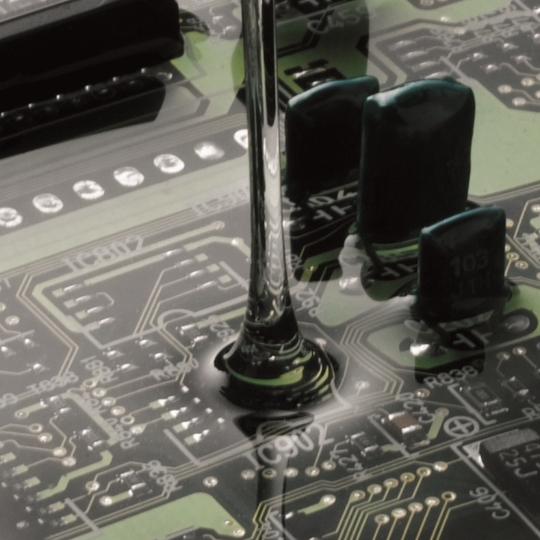
Electrical Insulation
|
 |
|
|
Thermal management
|
Flexibility
|
|
|
|
Weatherproofing
|
Easy Usability and Fast Curing
|
|
|
|
Why is fast curing at room temperature important?
|
Clear and ColourlessNot all dielectric silicone gels are clear and colourless but those that are, have some added benefits:
|
|
_______________________________
|
Key HV Technical Property |
Benefit for HV Assemblies |
|
Dielectric Strength & Volume Resistivity |
Provides the primary electrical barrier, preventing arcing, tracking, and shorting under high electrical stress. Crucial for long-term insulation performance. |
|
Exceptional Flexibility (Stress Relief) |
The gel structure absorbs mechanical stress from thermal cycling (expansion/contraction) and high vibration. This prevents cracking and maintains the critical seal, eliminating voids that initiate partial discharge (PD). |
|
Insulation Performance (Corona Resistance) |
Superior chemical stability resists degradation from moisture, chemicals, and the intense heat generated by power modules, ensuring the dielectric layer remains stable over time. |
|
Low Viscosity & Flowability |
Allows the material to fully penetrate complex geometries, densely packed windings, and tight spaces, guaranteeing a void-free fill that dramatically reduces the risk of PD initiation. |
|
Reworkability |
Gels can often be removed or repaired in situ, allowing HV design engineers to prototype, analyse failures, and service expensive components without replacement. |
_______________________________
Why HV OEMs Choose Dielectric Silicone Gels
When selecting a potting compound for high-voltage devices, the benefits of a silicone gel material are substantial:
-
Reduced Partial Discharge Risk: Complete, void-free encapsulation eliminates air pockets—the primary cause of partial discharge and premature failure in HV electronics.
-
Improved System Reliability: The stress-relieving nature prevents mechanical damage to fine wires, solder joints, and the insulation layer itself, ensuring long service life.
-
Simplified Manufacturing: The low viscosity and fast room-temperature curing options are cost-effective and allow for simpler, high-volume production processes.
-
Long-Term Dielectric Stability: Excellent non-conductive properties and a wide operating temperature range (typically -50°C to +200°C) ensure insulation integrity in harsh electrical and thermal environments.
-
Faster Failure Analysis: The option for non-destructive removal (reworkability) allows for critical failure analysis during development and post-warranty evaluation.
_______________________________
Products to Consider:
Momentive Silopren Gel 6209FC
This specific gel was developed for electronic potting applications, including hybrid IC insulation, power modules, and sensors. Key features include being clear and colourless (allowing for easy inspection of the HV assembly for voids), easy to pour, and offering fast room-temperature curing.
For more information or to speak to one of our technical team contact us on technical@techsil.co.uk.

Related Technical Resources
-
Learn about Momentive SilCool™ TIA208R High-Voltage Potting (Suggested internal link to related HV article)
-
View our full range of Potting Silicones